Blue Moon expected May 31, marking second full moon in May
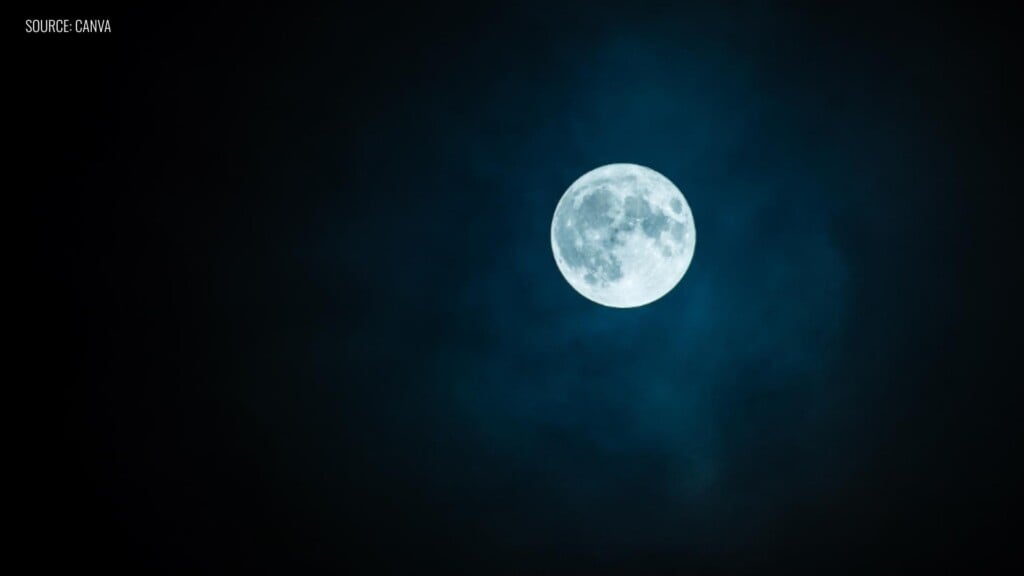
(WNKY) – The next full moon showing up on Sunday, May 31 is referred to as a Blue Moon since it’s the second full moon we will have this month, according to NASA.
To mark the occasion, viewers may want to take a photo.
NASA’s Lunar Photography Guide provides the following guidelines for those who wish to capture the night sky:
Smartphone
If you are using a smartphone, you will first need to use something to stabilize the phone, NASA says. If a tripod is not available, viewers can prop the phone against something steady.
Second, NASA says to plan out the composition of the shot.
Third, the guide says to turn off your flash and focus the camera on the moon “instead of the sky,” normally done by touching your screen. To avoid a blown-out, white image, NASA recommends lowering the brightness. The guide says it’s ideal if you can see some lunar features on your screen.
Fourth, NASA says to use a photo timer to avoid touching the phone when the photo is captured.
If your phone has settings that can change, such as ISO and aperture, NASA says to set a low ISO and a wide aperture.
Viewers can also try adjusting the shutter speed to ensure the moon is exposed well, according to NASA. The guide recommends starting with a faster shutter speed and adjusting downward.
Those with a telescope can also point a phone into the eyepiece to try to get a clear image, NASA says.
Digital or Film Camera
According to NASA, it is recommended to use a DSLR camera, but if that is not available, viewers can use equipment on hand. If possible, NASA says to take image in raw mode so more editing can be done later.
The guide further advises to do the following:
- Decide on the goal of the photographs.
- Put the camera in manual mode, and experiment to find the right balance of aperture, exposure time and ISO.
- Keep in mind the process is trial and error.
- Take photos and see how they turn out.
For the full, in-depth guide, click here.