WKU President kicks off university’s 118th academic year with annual Convocation address
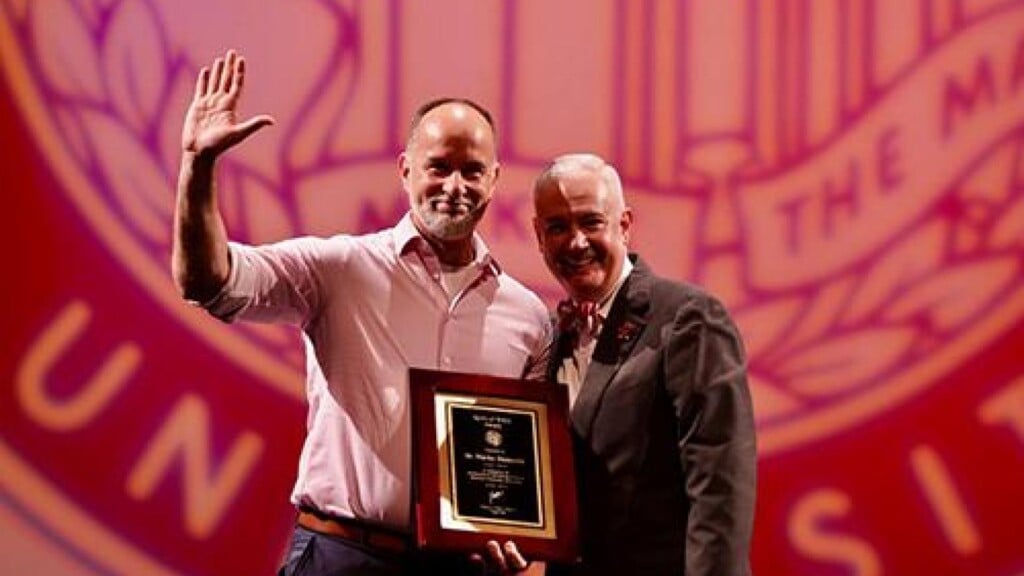
BOWLING GREEN, Ky. – Western Kentucky University President Timothy C. Caboni addressed faculty and staff during his annual Convocation address Monday, Aug. 12 in WKU’s Van Meter Auditorium.
During his address, he summarized the University’s accomplishments from the 2023-24 academic year and previewed the 2024-25 year.
Caboni began with announcing the university had raised $100 million for its Opportunity Fund.
The fund was originally established to support students facing financial obstacles and had an initial goal of $50 million, according to a release by the university.
In his Convocation address, President Caboni noted that the Opportunity Fund total now stands at more than $102 million and has enabled the creation of 267 new endowed scholarships.
“Altogether, during the Opportunity Fund campaign, we provided 20,205 students with private scholarship support,” he said.
Caboni also spoke about some of the university’s successes from the 2023-24 academic year. This included another national championship season for WKU Forensics and the 31st consecutive finish in the top eight nationally in the annual Hearst Journalism Awards Program.
Additionally, WKU was recognized by both the Gilman Scholarship and Boren Scholarship programs as a top producer in the nation. WKU again had more Gilman Scholarship recipients than all other Kentucky institutions combined.
He also highlighted the success of the University’s efforts to reach and engage its first-generation students, noting that roughly one-third of WKU students are the first in their family to attend college.
“These students often face distinct challenges, including financial constraints, lack of familial guidance and a limited understanding of the resources available to them,” he stated.
During the 2023-24 academic year, the University reached more than 700 first-generation students, Caboni noted, and WKU will continue to provide initiatives targeting this population this academic year.
Additionally, the president discussed the University’s increased investments in Living Learning Communities during recent years.
He shared that among first-time, first-year students, fall 2023 LLC participants returned in spring 2024 at a rate that was 4.5 percentage points higher than first-time, first-year non-LLC participants. He also shared that preliminary data for this fall indicates a retention rate 8.1 percentage points higher among LLC participants compared to non-LLC participants. Caboni noted that 782 students, nearly one-third of the University’s incoming class, will participate in an LLC this fall.
He also discussed the future of the Mahurin Honors College and paid tribute to Dr. Craig Cobane, the former executive director of the Honors College, who passed away in May of this year.
“Since his arrival at WKU in 2005, Craig Cobane served as a respected colleague, mentor, advocate, teacher and, most importantly, a cherished friend,” he said. “He led the transformation of what was our Honors Program into the Commonwealth’s first true Honors College in 2007.”
Caboni shared that he will appoint a task force this year to consider revisions to the Honors College and its curriculum and programming that might reinvigorate course offerings and increase interest and availability to an even wider range of WKU students.
Caboni discussed a number of improvements to WKU’s campus, noting the important role campus plays in student recruitment.
“Many of our students share with us that it was their campus visit that confirmed their decision to choose WKU,” he said.
He shared that since 2017, the University has invested $649 million in campus improvement projects.
Most recently, the university dedicated a new home for its Soccer and Softball teams, and work continues on a new building to house the Gordon Ford College of Business, made possible by a $74.4 million capital allocation from the Kentucky General Assembly.
In 2023, WKU broke ground on the Hilltopper Fieldhouse, which will serve as the home of Forensics and Esports and will provide rehearsal and practice space for the Big Red Marching Band and WKU Athletics. Caboni also highlighted upcoming renovations to Cherry Hall and discussed a new building to replace the Academic Complex, which will be funded by a $160 million capital project appropriation, the largest such appropriation in WKU history.
“As guardians of this remarkable space, we have a responsibility to both maintain our picturesque campus and to constantly reimagine how it might support the needs of tomorrow, ensuring that it serves our students, our faculty, our staff and our broader community for generations to come,” he said.
Since 1926, WKU has been accredited by the Southern Association of Colleges and Schools Commission on Colleges, and in 2025 SACSCOC will assess the university as part of its ten-year reaffirmation of accreditation process. Accreditation is vital to ensuring the quality of education students receive and can affect an institution’s ability to offer federal financial aid and transfer credits to other institutions.
In his Convocation address, Caboni outlined the timeline for the University’s reaffirmation of accreditation. Currently, WKU’s SACSCOC leadership team is finalizing the off-site compliance certification, an overview of the University’s administration, including policies and procedures. That work will wrap up in November, and the University will receive feedback and questions to which it can respond. In March, an on-site review committee will visit the main campus in Bowling Green, as well as two of WKU’s regional campuses. Finally, in December the SACSCOC Board of Trustees will meet to make its decision on WKU’s reaffirmation of accreditation.
Caboni provided an overview of WKU’s research successes from the previous academic year. In fiscal year 2024, the university received nearly $28.7 million in external funding to support basic and applied research, public service projects, student services, instructional awards and equipment acquisition. That figure represents an increase of almost $6.5 million, or 29%, compared to the previous fiscal year.
Increasing research activity is an important component in WKU’s goal to become Kentucky’s first Carnegie classified R2 institution.
Caboni noted that this classification provides multiple benefits to the institution.
“We pursue this designation not for the recognition it conveys,” he said. “We pursue it because to achieve that classification requires us to evolve, grow and stretch; to continue to enhance our research capacity; to grow the percentage of faculty successfully pursuing federal grants; to invest in select trans-institutional research pilots; to build relationships with external partners; to address together pressing regional and national challenges; and to integrate even more of our students into basic and applied research activities.”
Caboni noted that to reach R2 status, a university must have at least $5 million in annual research and development expenditures. He shared that in recent years, WKU’s research expenditures have exceeded $10 million.
Additionally, a university must award at least 20 research doctorates annually. Central to the University’s push to meet that threshold is the ability to offer PhD degrees. He noted that this year the University will work closely with CPE and an external organization to determine WKU’s path toward offering PhDs, focusing heavily on the programs the University could offer that build upon its existing resources and successes.
The president discussed the important role of WKU’s 285,000-square-foot Innovation Campus in connecting students, staff and faculty with entrepreneurs and industry leaders to create jobs, develop talent pipelines and advance the region’s economy. Notably, he highlighted the increased partnership between the University and Holley Performance Brands. Recently, Holley relocated its research and development and engineering teams to the Innovation Campus headquarters on Nashville Road. As part of WKU’s partnership with Holley, the Innovation Campus now has a second location in a 35,000-square-foot portion of Holley’s facility on Russellville Road in Bowling Green.
The president spoke about the importance of each of WKU’s regional campuses, located in Elizabethtown, Glasgow, Owensboro and Somerset.
“These campuses make possible opportunities for students who cannot come to our Hill – those who would otherwise not have access to a college experience – offering a place, within reach, to achieve their WKU degrees,” he noted.
Among the accomplishments of the regional campuses, Caboni highlighted the development of Signature Regional Programs, launched last fall.
This initiative represents a collaboration between each regional campus location and WKU’s five academic colleges and defines 11 degree programs available in full at the regional campuses. These programs will respond to the greatest demands within WKU’s service area.
He shared that each regional campus location is on track to increase their on-campus enrollment this fall.