The Mystique of Thunderstorms
BOWLING GREEN, Ky. – They’re loud. They sometimes pop up out of nowhere. They can be scary…and destructive.
Thunderstorms are a work of art by Mother Nature.
They form from a simple process: rising air, either from hot weather, like a summer day, or from cold fronts and warm fronts.
As the air rises, that parcel or “piece” of air cools down. And as it cools down, moisture gets squeezed out from between the air molecules when the air gets up to a height in the atmosphere known as the lifting condensation level, and that forms clouds.
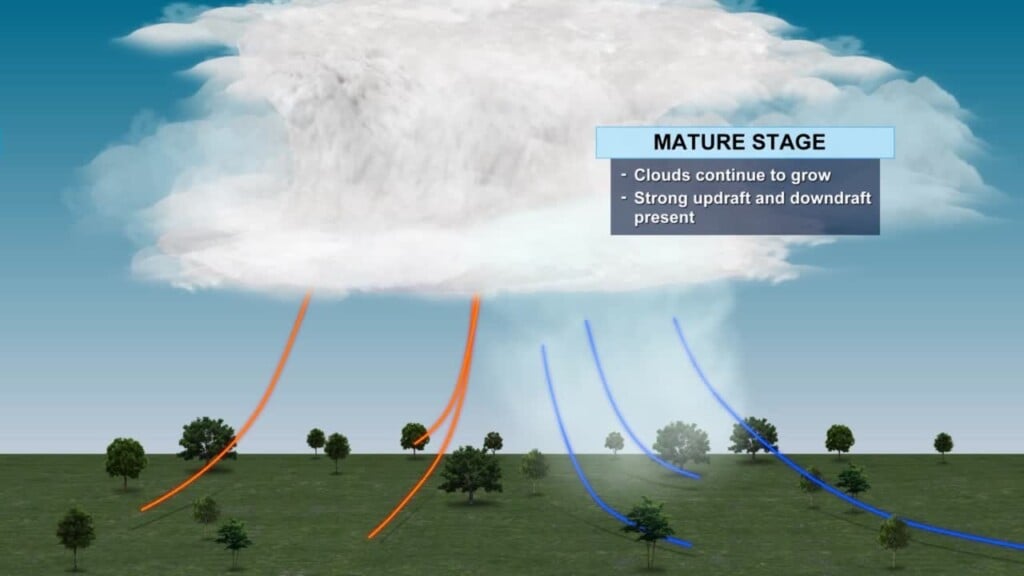
There are three stages of cloud formation for thunderstorms…cumulus clouds formation, the mature stage and the dissipating stage.
The first stage of clouds, the cumulus stage, is when the cloud still growing taller. Sometimes, rain falls from cumulus clouds.
During the mature stage, the cloud has grown into a cumulonimbus cloud which resembles an anvil since the top of the cloud hangs out further than the base of the cloud.
This is when heavy rain and wind are produced by the cloud. If there’s enough turbulence inside the cloud, hail may fall.
That turbulence also helps set up positive and negative charges in the cloud which forms the basis for lightning and then thunder. The electrical charges are generated when water droplets and ice particles collide with each other.
Tornadoes sometimes form during the mature stage, too.
During the dissipating stage, the cloud begins to collapse on itself. Although the storm is winding down, some of the strongest winds blow straight down from the cloud. Extremely heavy rain often falls from a storm during the dissipating stage as it “rains itself out.”
While thunderstorms only last a few minutes, the effects of thunderstorms…from downed trees and power lines due to high winds, hail damage to cars and flash flooding from the torrential rains often dropped by thunderstorms…can last for hours to days or even longer.