McConnell comments on war powers, next steps in Venezuela
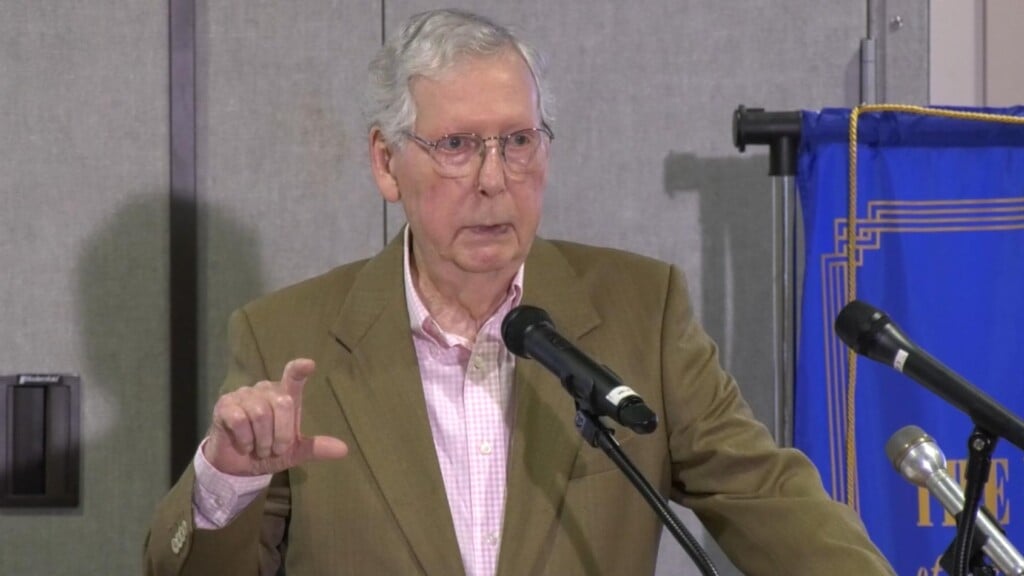
WASHINGTON – U.S. Sen. Mitch McConnell (R-KY) submitted the following remarks for the record Thursday ahead of the Senate’s roll call vote on the motion to discharge from Foreign Relations Committee, S.J.Res.98, Kaine War Powers Resolution (Venezuela):
“I’d like to make just a few brief observations ahead of the vote on Senator Kaine’s War Powers resolution. The War Powers Act is not the law I would have written, and there are reasonable questions about its constitutionality. But it’s been the law now for over 50 years. And it’s important to remember what it was designed to prevent… and, even more importantly, what it wasn’t. Back in 1973, the goal was preventing another Vietnam. The idea was to impose guardrails against the large-scale, indefinite commitment of U.S. troops abroad. And in shutting that door, the law very intentionally reaffirmed our founders’ decision to leave another door open.”
“The law grants presidents clear authority for the limited use of military force. And of the many occasions over the years when colleagues on both sides of the aisle have invoked the War Powers Act to condemn such limited use of military force – by Presidents of both parties – I can’t recall a single one in which Congress managed to change the facts and artificially constrain the Commander-in-Chief’s authority.
“This time is no different. The President was well within this authority in his decision to bring Nicolas Maduro to justice. How do we know? A number of ways:
“First, plain statute: Notification of Congress within 48? Check. Withdrawal within 60 days? Try 60 minutes!
“What’s more – recent history provides clear precedent from presidents of both parties. What authority did this operation exceed that President Obama or President Reagan did not exceed in operations in Libya? Or President Clinton in Kosovo? What makes this time different than President Biden’s strikes in Syria or Yemen? Certainly, there’s little daylight between the legality of this operation and the one President H.W. Bush undertook to apprehend Manuel Noriega in Panama.
“You don’t have to agree with a president’s approach to national security policy to acknowledge his compliance with the law and his constitutional authority for the use of force… Which makes the invocation of the War Powers Act such a tired and blunt instrument. For my part, I’ve consistently opposed resolutions like these aimed at constraining presidents’ constitutional authority. And I’ve done it on behalf of presidents of both parties.
“I’m old enough to remember when – during President Obama’s feckless dealings with Iran – no less than the future Democratic Leader insisted that, ‘we should never take the military option off the table’.
“But every one of our colleagues remembers last summer when the frequent fliers of the War Powers Resolution reached yet again for their favorite tool after the President’s decision to degrade Iran’s nuclear program without putting a single American boot on the ground.
“Of course, there are serious questions at hand to which the Senate and the American people should expect serious answers from the Commander-in-Chief. The President’s authorities to conduct military operations may be wide and well-established, but they incur a responsibility to situate decisive actions in broader, longer-term strategy.
“Maduro is an authoritarian thug. He reduced a once-prosperous neighbor of America to an impoverished vassal of Cuba, Russia, Iran, and China. He profited from the flow of lethal drugs to America. He spat in the face of Venezuelan voters. And, until very recently, he slept in peace while they starved.
“A Western Hemisphere without him or his ilk in power serves America’s interests. But clearly, Venezuela and the hemisphere have a ways to go.
“To the extent that our colleagues are concerned about the mechanisms and timeline of a transition to democratically-elected Venezuelan leaders, I share their curiosity. If they want to know more about the President’s longer-term strategy to stabilize Venezuela and the Western Hemisphere, so do I!
“Suffice it to say that whatever the objective, whatever the strategy, America is well-served when its Presidents secure enduring bipartisan support for their foreign policies. President Obama ignored Congress in pursuing a reckless and bad nuclear deal with Iran. Unsurprisingly, that deal did not endure.
“Successfully returning Venezuela to its role of stable, prosperous, democratic neighbor is a noble goal… but an ambitious one. It doesn’t come without risk. And it’s worth making the clear case to the country.
“I appreciate the Administration’s willingness to brief Senators on the sensitive details of a tactical victory. But they owe it to the American people – and, frankly, the long-suffering people of Venezuela – to lay out the path to strategic success in much greater detail.
“If the aim is to reestablish American primacy in its near abroad, great. If the idea is to evict enemies who hate America from a valuable foothold in our region, onward!
“A stable Venezuela, led by duly elected Venezuelans, will leave Americans safer and more secure. The Administration should explain how that end goal will be achieved.
“In the meantime, I will oppose the Kaine resolution, and would urge my colleagues to do the same.”
Sen. Rand Paul also issued a statement on X Monday afternoon in response to Maduro’s capture. He expresses support for the people of Venezuela, saying they should not mourn his removal.
Paul also cites the founding fathers limiting the executive’s power to go to war without Congress’s approval as a way to limit war to acts of defense, and hopes this is a second chance for the Venezuelan people.
RELATED: SOKY Indivisible holds protest in response to recent U.S., Venezuela conflict
News 40 will provide additional information as it is released.